Key Dates
Common sense suggests that greater weight can be attached to information about Deterding published while he was still an extremely wealthy director of multiple companies within the Royal Dutch Shell Group, which he was until the day he died. Until then, he had the opportunity to publicly refute the veracity of allegations, news stories, statements, or comments made about him and, if necessary, take legal action. There is no evidence that he did so.
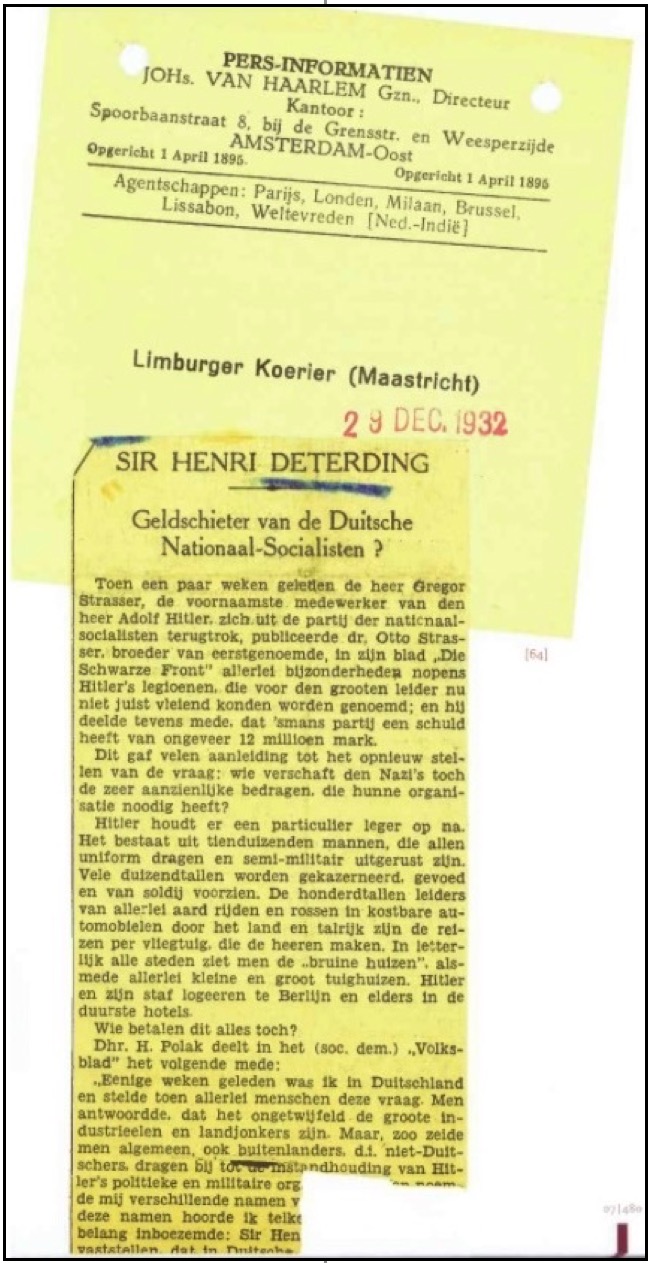
I have provided an index of some key dates. Henri Deterding served as chairman of the combined Royal Dutch/Shell oil company between 1900 and 1936.9 Press reports in January 1931 linked Deterding to discussions about a possible benzine monopoly in Germany. In or around 1931, Deterding bought a hunting estate in rural Mecklenburg, Germany.10 By 1932, Dutch newspaper coverage was already naming Deterding as a possible funder of the National Socialists while the Nazi Party was deeply in debt. The Reichstag fire, a pivotal event in the rise of Hitler, took place in January 1933.11 On 30 January 1933, Hitler was appointed as Reich Chancellor of Germany.12 13 Hitler’s appointment was welcomed by Deterding and by November 1933, Deterding said that he had met Hitler.14 Late in 1933, Rhenania-Ossag launched touring maps and promotional material stressing Shell’s contribution to the German economy and claiming that Germany had received 170 million Reichsmarks from the Shell Group. On 3 April 1933 the Nazi representatives of the works council of Rhenania-Ossag, the Shell subsidiary and operating company in Germany, presented management with demands for the immediate dismissal of all Jewish directors.15 In May and June 1933 the board of directors of Rhenania-Ossag was “thoroughly overhauled” with all Jewish members removed and a Nazi party member appointed, joining one already in place.16
The far-reaching changes to the Rhenania-Ossag board could not have taken place without the full consent of Royal Dutch Shell.17 Germany’s rearmament programme began in secret in 1934.18 On 26 October 1934, The New York Times published a Reuters article reporting that Deterding was the guest of Hitler during a four-day meeting at Berchtesgaden. Deterding was said to be keen on securing a monopoly position for petrol distribution in Germany.19 By September 1935, Jean Baptist August Kessler II,20 a senior Royal Dutch Group director, was worried about Rhenania-Ossag losing its position in the German gasoline market.21 Although Kessler had the remit for the Group’s German affairs, Deterding took a greater interest following the advent of the Nazi regime.22 From September 1935, the German Foreign Office seconded one of its staff to Deterding as a personal assistant for political matters.23 In October 1936, Dr. W. Kruspig, GM of Rhenania-Ossag,24 started negotiations with representatives of Farben and Jersey Standard Oil about a joint synthetic gasoline plant to be built at Politz. The Shell Group initially refused to move forward with the project, but by February 1937, reversed the decision. “Because the Group wanted at all costs to avoid its commitment to a synthetic gasoline plant becoming public knowledge, two banks fronted as shareholders in Hydrierwerke Politz.”25 According to research by Shell’s historians Sir Henri Deterding, by June 1936 “had effectively retired and gone to live in Germany,” though “he continued to meddle in Group affairs throughout the summer.”26
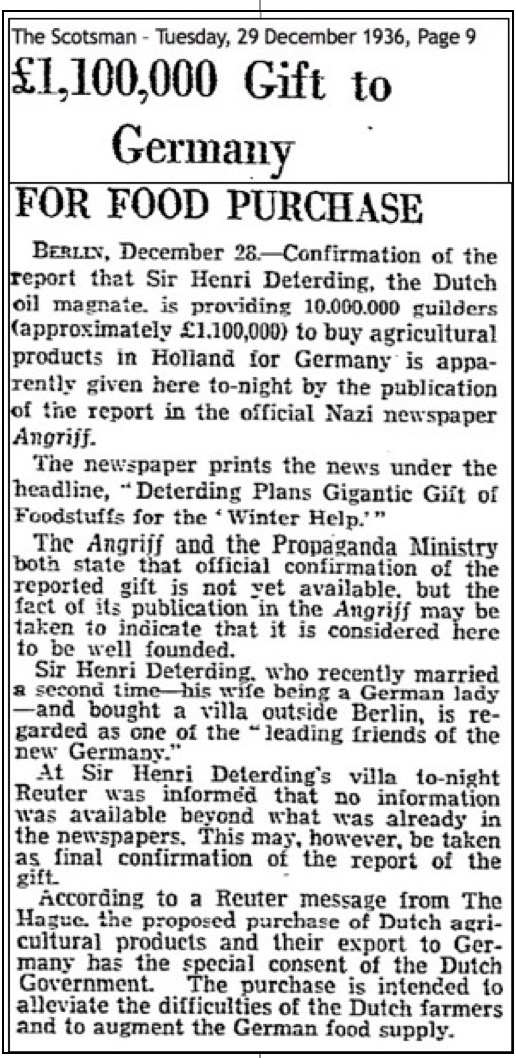
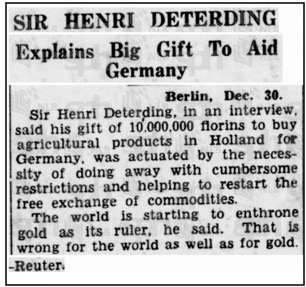
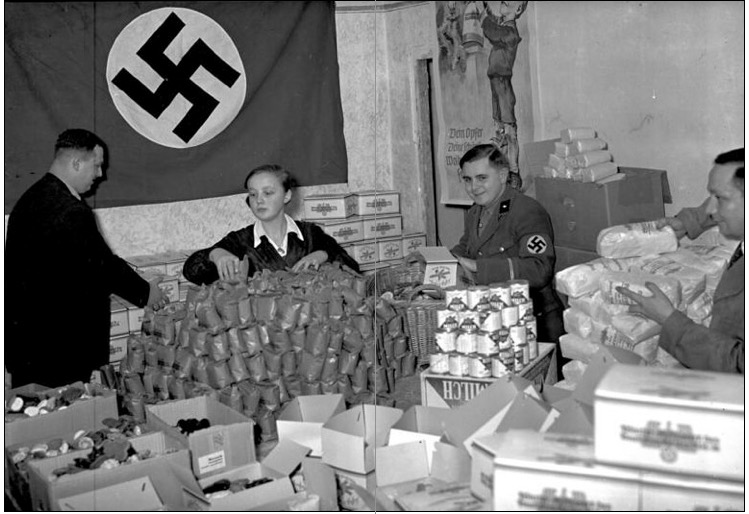
In December 1936 there were global news reports about Deterding’s food donations to Germany. Reuters had already reported the first massive donation on 20 December 1936, while Deterding was still Director-General, because his resignation did not take effect until 31 December 1936. According to Shell’s own records, Deterding donated 10 million guilders in surplus Dutch foodstuffs to the Winterhilfswerk27 (Winter Relief) organisation in Germany.28 The Winterhilfswerk scheme, involving donations of food, clothing and coal, allowed Nazi regime funds to be diverted to the military buildup. One account stated that 7,000 railway wagons were required for the first immense delivery. On 26 October 1936, the Daily Express reported his resignation29 as President of Royal Dutch Petroleum Company and correctly stated that he retained his seat on the board. This was later confirmed30 in an article published by The Times. After Deterding’s retirement as leader, the Royal Dutch/Shell Group continued to do business with the Nazis in a variety of ways under Kessler and his Royal Dutch director colleague, Jan Carel van Panthaleon Baron van Eck.31 From 1937 Deterding, still a Shell director, was influenced by a personal secretary with outspoken Fascist sympathies and helped to finance a paper published by a Fascist splinter group in the Netherlands.32 In June 1937, The New York Times published an article reporting that Deterding was sending more food to Germany.33 The publication of the book “The Most Powerful Man in the World: Sir Henri Deterding” by Glyn Roberts, took place in June 1938,34 while Sir Henri was still active, still a Royal Dutch Group director and still able to legally challenge the accuracy and truthfulness of the content.
In relation to the Politz project, “In February 1939, the Group received an ultimatum: if Rhenania-Ossag would not take its full share in the costs, the government would interpret this as an infringement of the company’s duty under law to act in the interests of the German people and the German State, and put it into administration.” This made Group managers capitulate and give Rhenania-Ossag permission to raise its financial commitment to Politz.35 Sir Henri Deterding died in St. Moritz, Switzerland on 4 February 1939 several months before the outbreak of the Second World War.36 His funeral took place on 10 February 1939.37 In January 1940, the Nazi government appointed a “Verwalter” or caretaker manager to take charge of Rhenania-Ossag, the operating company of Shell in Germany.38 39 DIRECTORSHIP DATES (Dates of Deterding Royal Dutch/Shell directorships from “A History of Royal Dutch Shell Appendices. Figures and Explanations, Collective Bibliography, and Index. Pages 93 to 99.)40 Sir Henri Deterding was the most senior executive of Royal Dutch from 17 December 1902 until 31 December 1936 and a supervisory director of multiple Royal Dutch Shell group companies until the day of his death, 4 February 1939. According to “A History of Royal Dutch Shell: volume 1”: – page 490, Deterding did not lose power over the business until his death.41 Sir Henri Deterding was a director of Shell Transport from 11 April 1907 until 1 January 1937. Sir Henri Deterding was General Managing Director of a Royal Dutch Shell Group company, Bataafsche Petroleum Maatschappij, from 28 June 1907 to 1 January 1937 and a supervisory director from 1 January 1937 until 4 February 1939.
Sir Henri Deterding was a General Managing Director of Anglo-Saxon Petroleum Company between 1 July 1907 and 31 December 1936 and a director between 1 July 1907 and 4 February 1939. In November 1955, The Shell Petroleum Company Ltd took over the assets of Anglo-Saxon, which ceased to function as a separate company. Sir Henri Deterding was a director of Asiatic Petroleum Company, renamed The Shell Petroleum Company Ltd in January 1946, from 8 July 1903 until 13 January 1937. Each of the directorships was held in his full name: Henri Wilhelm August Deterding. In practice, he was the leading executive director of multiple companies within the Royal Dutch/Shell Group until 31 December 1936 and remained a director of multiple Royal Dutch Group companies until his death on 4 February 1939.
Notes
9. Information from Wikipedia article “Henri Deterding” as of 12 July 2014. Source 1 ↩
10. Information from page 477 “A History of Royal Dutch Shell: Volume 1” ↩
11. Information from page 467 of “A History of Royal Dutch Shell: Volume 1” ↩
12. Link to Wikipedia article: “Adolf Hitler” - see section “Appointment as chancellor” Source 1 ↩
13. Information from page 465 of “A History of Royal Dutch Shell: Volume 1”: “The Nazi regime which came to power in January 1933…” ↩
14. Information from page 477 of “A History of Royal Dutch Shell: Volume 1” ↩
15. Almost verbatim extract from 469 of “A History of Royal Dutch Shell: Volume 1” ↩
16. Information from page 469 of “A History of Royal Dutch Shell: Volume 1” ↩
17. Verbatim extract from 469 of “A History of Royal Dutch Shell: Volume 1” ↩
18. Verbatim extract from page 472 of “A History of Royal Dutch Shell: Volume 1” ↩
19. Link to shellnews.net webpage containing a New York Times article published on 26 October 1934 under the headline: “REICH OIL MONOPOLY SOUGHT BY DETERDING” ↩
20. Link to Wikipedia article “Guus Kessler” Source 1 ↩
21. Information from page 471 of “A History of Royal Dutch Sell: Volume 1” ↩
22. Information from page 477 of “A History of Royal Dutch Shell: Volume 1” ↩
23. Verbatim extract from page 478 of “A History of Royal Dutch Shell: Volume 1” ↩
24. Information from page 464 of “A History of Royal Dutch Shell: Volume 1” ↩
25. Information from page 473 of “A History of Royal Dutch Shell: Volume 1”: Text in italics is taken verbatim from page 473. ↩
26. Information from page 486 of “A History of Royal Dutch Shell: Volume 1” ↩
27. Link to Wikipedia article: “Winterhilfswerk” Source 1 ↩
28. Information from page 483 of “A History of Royal Dutch Shell: Volume 1” ↩
29. Link to royaldutchshellplc.com webpage containing Daily Express article published 26 October 1936 under the headline: “Sir Henri Deterding, Oil King, To Resign” Source 1 ↩
30. Link to shellnews.net webpage containing The Times Obituary of Sir Henri Deterding published 6 February 1939 ↩
31. Information from page 485 of “A History of Royal Dutch Shell: Volume 1” ↩
32. Almost verbatim extract from page 483 of “A History of Royal Dutch Shell: Volume 1” ↩
33. Link to a royaldutchshellplc.com webpage containing an article published by The New York Times on 8 June 1937 under the headline: “Deterding to Distribute More Food in Germany” Source 1 ↩
34. See Time Magazine review published 27 June 1938 about the relevant book under the headline: “Ruddy Old Gent: THE MOST POWERFUL MAN IN THE WORLD: THE LIFE OF SIR HENRI DETERDING—Glyn Roberts—Covici-Friede ($3).”: ↩
35. Information from page 474 of “A History of Royal Dutch Shell: Volume 1”: Text in italics is taken verbatim from page 474. ↩
36. Link to shellnews.net webpage containing an article published by The New York Times on 5 February 1939 under the headline: “HENRI DETERDING DIES IN ST. MORITZ” ↩
37. Link shellnews.net webpage containing an article by The Times published on 11 February 1939 under the headline: : “SIR HENRI DETERDING’S FUNERAL” ↩
38. Information from page 78 of “A History of Royal Dutch Shell: Volume 2.” ↩
39. Information from page 22 of “A History of Royal Dutch Shell: Volume 2” ↩
40. Information sourced from pages 93 to 99 inclusive of “A History of Royal Dutch Shell Appendices. Figures and Explanations, Collective Bibliography, and Index.” ↩
41. Link to 38 pages, including page 490, from: “A History of Royal Dutch Shell: Volume 1” ↩