Chapter 7: Evidence of Deterding/Shell financial support for the Nazis
This chapter may seem more like a reference index, but I wanted to provide an unprecedented volume of evidence within a single reference source. Extracts from relevant articles and books, many authored before World War II, are assembled here in date order and provide compelling evidence of what transpired all those years ago. This information, published by independent sources, confirms the financial support Royal Dutch Shell/Deterding provided to Nazi Germany. It was given in a variety of forms: investment, jobs, taxes, money, food donations, oil on long-term credit and revenues from Shell advertising in a Nazi newspaper. One point should be clarified at the outset. The authors of “A History of Royal Dutch Shell: Volume 1”117 described the food donations as a gesture after Deterding’s retirement. In fact, his retirement as Director-General took effect on 31 December 1936, while Reuters reported the first massive donation on 20 December 1936. As can be seen from numerous international news reports at the time, Sir Henri Deterding was still the Director-General/Chairman of the Royal Dutch Shell Group when the initial great donation of food was announced. He also remained a Shell director until the day he died. The scale of the undertaking was immense: one account stated that 7,000 railway wagons were required for the first immense delivery.
All of his financial support for Hitler and the Nazi party took place while he was a director of multiple companies within the Royal Dutch Shell Group. His Shell colleagues must have been well aware from all of the international publicity about the massive financial aid, yet let Sir Henri remain as a director. Section “A” on page 14 of a Military Tribunal document118 arising from the War Crimes Trials at Nuremberg Germany dated 6 December 1947, had the heading “Financial Support of Hitler and Nazi Party.” It mainly covered the financial support given to the Nazi Party at a critical time by Farben. It states on page 14 that “The financial support thus given by Farben along with other industrialists contributed to Hitler’s seizure and consolidation of power.” On the same page it makes direct reference to “….contributions to the winter aid scheme (Winterhilfswerk)…” as part of the “important contributions.” It seems proper to give extra credence to information published while Sir Henri was still alive and therefore had the opportunity to legally challenge any statement or allegations about him, which were inaccurate. As previously indicated, Sir Henri Deterding passed away on 4 February 1939.
Chronological extracts from 1931 onwards.
1931
Press reports in January 1931 linked Deterding to discussions in Berlin about a possible benzine monopoly. Even at that early stage, monopoly arrangements inside Germany were already being attached to his name.
1932
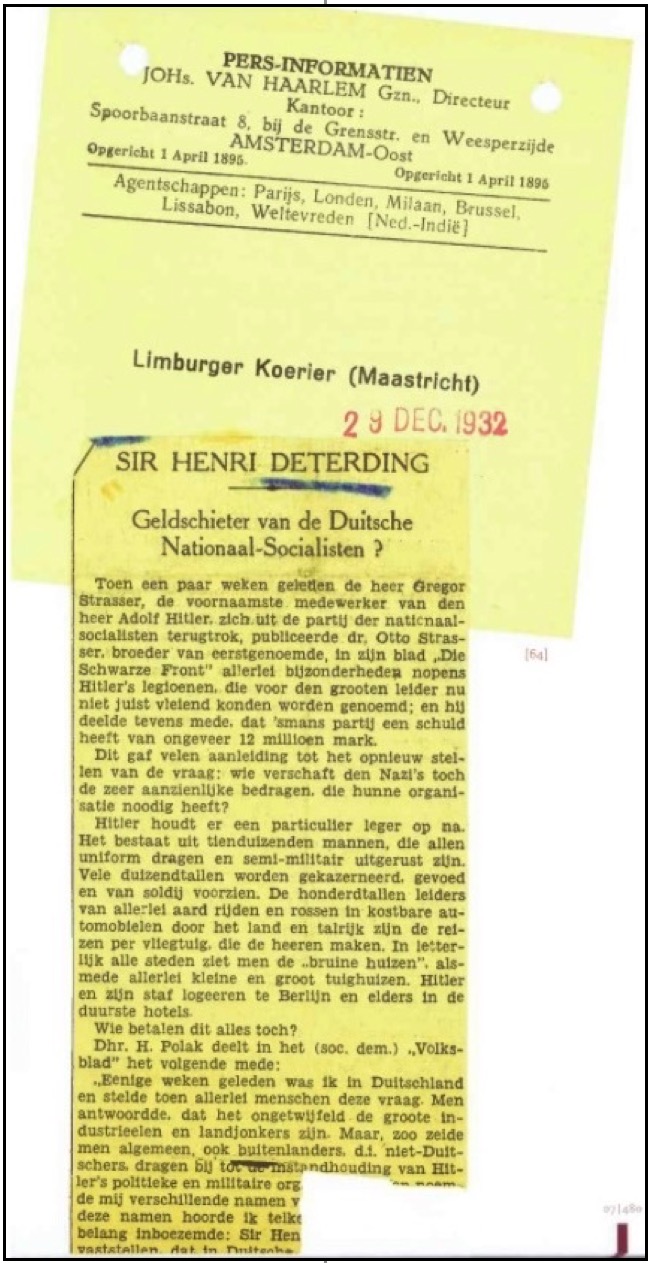
In April 1932, the Nazi party in Berlin reportedly dismissed the notion that Sir Henri Deterding, “head of the Royal Dutch Petroleum Company,” had donated money to the German fascist cause as a “shameless swindle”.119 This is one of the few examples I am aware of in which the Nazis issued a denial. Evidence from the Dutch newspaper Limburger Koerier comes from page 480 of “A History of Royal Dutch Shell Volume 1.” The text printed in red on page 480 states: “This extract from the Limburger Koerier of 29 December 1932 was only one of the many articles in the national and international press speculating about who might be funding the Nazi party, which was deeply in debt. Deterding’s name came up more than once.”
The graphics show a cutting of the Limburger Koerier article and a related receipt or note with a date stamp of 29 December 1932. The cutting is exactly as shown, with the rest of the article missing, conveniently, just when the name “Sir Hen” appears.120 The headlines state: SIR HENRI DETERDING Sponsor of the German National Socialists? The article revealed that the Nazi party was 12 million marks in debt. It listed examples of extravagant spending by Hitler and his private army, mentioning expensive houses, hotels, cars, horse riding and air travel. The article goes on to speculate who was funding it all. It makes reference to foreign industrialists contributing to Hitler’s political and military organization. The part substantiating the headline and sub-headline, which suggests exactly who was behind the funding, has been judiciously removed or censored by an unknown party.
1933
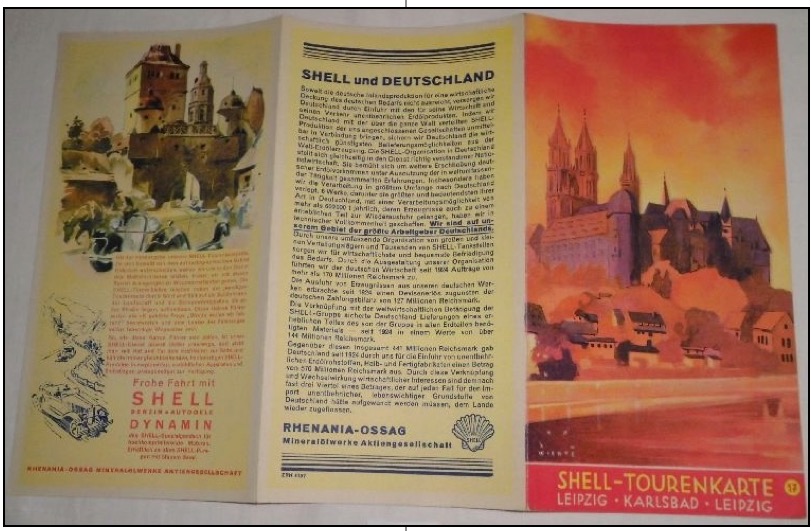
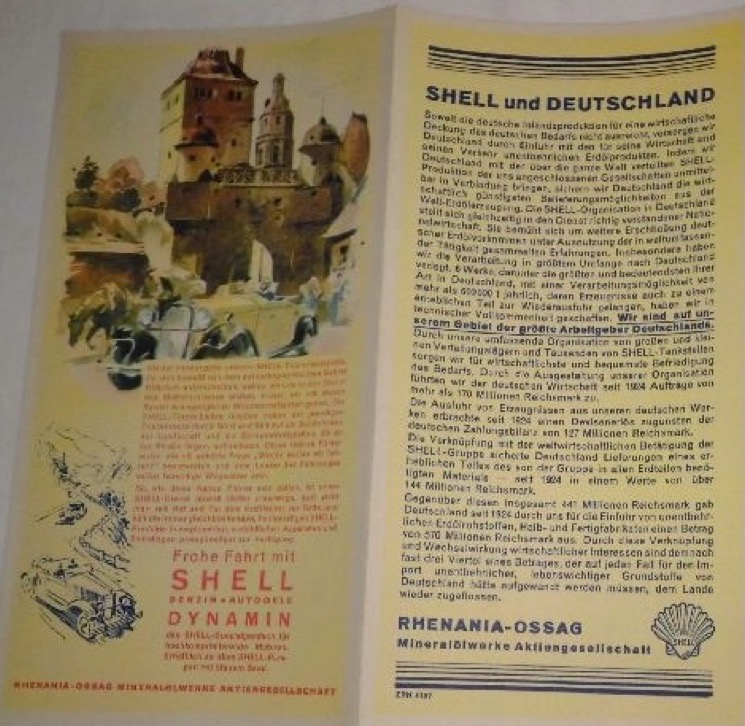
On 30 January 1933, Adolf Hitler was appointed Reich Chancellor.121 In the same year, the German subsidiary of the Royal Dutch Shell Group, Rhenania-Ossag, launched a series of motorists’ touring maps which boasted about Shell’s contribution to the German economy, in other words to the economy of the Nazi state. Extract from the text: Die SHELL-Organisation in Deutschland stellt sich gleichzeitig in den Dienst richtig verstandener Nationalwirtschaft. Sie bemuht sich um weitere ErschlieBung deutscher Erdölvorkommen unter Ausnutzung der in weltumfassender Tatigkeit gesammelten Erfahrungen Roughly translated, this means that the Shell organisation in Germany was utilising its global experience to support the German national economy.
An example map is displayed on page 470 of “A History of Royal Dutch Shell: Volume 1”122 The header text above the map states: Late in 1933 Rhenania set up an information office for motorists and launched a large series of motorists’ touring maps, emphasizing – despite some political doubts from The Hague – the importance of Shell as a contributor to the German economy. The wider “SHELL und DEUTSCHLAND” material went beyond vague patriotic language. It claimed that the German economy had received 170 million Reichsmarks from the Shell Group and listed still larger sums in other categories. The message was unmistakable: Shell wished Germany to understand how much economic value it claimed to bring to the Nazi state.
There are several references within this book to Johannes Steel, with extracts from his writings. He authored the book “Hitler As Frankenstein” published by Wishart & Co in 1933.123 Johannes Steel124 (born Herbert Stahl, 1908-1988) was the son of a German-Dutch landowner. When the Nazis took power in Germany he fled to the USA, worked as a journalist for the New York Post, and later became widely followed as a radio commentator. Extracts from his book, “Hitler As Frankenstein”: From page 22 Finance is Adolf Hitler’s personal prerogative. Funds are centralised under his direction and he is virtually the only person who can authorise disbursements. It is no concern of the mass of the brown shirts, in the view of their leader, to know where the money comes from or how it is spent. From pages 88 & 89 Dr. George Bell was present at several of these conferences as a delegate of Hitler and Deterding jointly. For Dr. Rosenberg, who at that time had been just two years naturalised in Germany, had become Hitler’s expert in foreign affairs, and he had advised Deterding, through the medium of Dr. George Bell, who brought about the contact, as to the attitude the Hitlerites would take in regard to the question of the Polish Corridor and the Soviet Ukraine, where there are rich supplies of oil. Rosenberg suggested to Deterding, through Bell, that at an appropriate moment unrest should be fostered in the Ukraine, and an attempt be made with the aid of Germany to wrest the Soviet Ukraine away from the Soviet Union and give it back to Poland, to whom it had belonged at the time of the ancient Polish kingdom. Germany in return should receive the Corridor back, so satisfying the Hitlerites’ nationalistic ambitions, and Sir Henri Deterding should be rewarded with mineral concessions for his efforts to persuade responsible British quarters to give tacit support to such an undertaking. Anyway, from the day of the Ukrainian Conference, Deterding has been supporting Hitler with considerable sums of money (which found their way into the Hitler exchequer through Dr. Bell), hoping that if the Hitlerites came to power, they would pursue an anti-Soviet policy.
On 1 December 1933, an American newspaper in Wisconsin, The Stevens Point Daily Journal, published an article under the headline: “Ex-Nazi Member ‘Opens” Mystery of Hitler Finances.”125 It contained reference to the Steel book, “Hitler as Frankenstein”: Extract: The book “Hitler as Frankenstein,” recently published by Wishart & Co., and written by Johannes Steel, a former member of the Nazi movement, although apparently not in the uniformed branch, contains some extraordinary facts about Nazi financing – if facts they are. If they are not, they ought to be proven untrue by those against whom the charges are made. Great Britain is listed in the book as one of the most productive fields for the Hitlerites’ money-collecting activities. The main contributor appears to have been Sir Henri Deterding, the untiring advocate and organizer of foreign action against Soviet Russia. The Nazi emissary Alfred Rosenberg persuaded him that the Nazis would help him to important concessions in Ukraine.
The following is a direct extract from a book by Edgar Ansell Mowrer, “Germany Puts The Clock Back,” first published in 1933 by Penguin Books Limited.126 From page 114.
Sir Henry Deterding was accused by unfriendly Germans of having put up a considerable sum for the 1932 presidential campaign in the hope, or on the promise, of being granted an oil monopoly in the Third Empire.
1934
In 1934, Johannes Steel published a further book, “The Second World War”127 Extract from page 99 …had been advocating foreign action against the U.S.S.R., saw great possibilities in this plan and from that day on Deterding supplied the Nazis with money. This money was transmitted by Dr. Bell, who was murdered by Storm Troopers in March 1933, when he tried to sever his connection with the Nazis.
On 8 November 1934, an American newspaper in New Brunswick, New Jersey, The Daily Gleaner, published instalment four of a serialisation of the Steel book, “The Second World War.128 Extract: Nazi foreign policy as a whole is based upon the plans of Alfred Rosenberg now the head of the Foreign Office of the National Socialist Party. As far back as 1926, Rosenberg through his secretary, Dr George Bell, a Scotchman naturalised in Germany, established contact with Sir Henri Deterding, the British oil magnate. He informed Sir Henri of the foreign political programme which the National Socialists intended to pursue when they achieved power. Sir Henri, as well as the directors of the Lena Goldfield, who for a long time had been advocating foreign action against the U.S.S.R., saw great possibility in this plan, and from that day on Deterding supplied the Nazis with money.
The World Diary129 by Quincy Howe, first published in 1934, contains information confirming that Deterding contributed to Hitler’s campaign funds. It also confirmed the role played in such transactions by Dr. George Bell, as an agent acting for Deterding in the relationship between Deterding and Hitler. (The publication contains nearly 400 pages and although the pdf file is condensed, still takes a few minutes to load. Also note that the first four pages are blank and there are more blank pages inside the book.) Extracts from pages 57, 41 & 59 While British industrialists were fighting against the same group of German industrialists whom Thyssen also opposed, the foremost British oil magnate gave funds to Hitler. His eyes, however, were on Russia rather than Europe. Sir Henri Deterding, director general of the Royal Dutch-Shell Oil Company, had married a White Russian wife and had lost valuable oil properties in Russia at the hands of the Bolsheviks. According to Antoine Zischka, author of The Secret War for Oil, a book that carries the endorsement of Francis Delaisi, Deterding maintained a special agent in Hitler’s camp, Dr. George Bell, a naturalized German of Scotch birth. “Through the hands of Bell,” wrote Zischka, “enormous sums of money flowed from Deterding and others as gifts to the National Socialist Party.” M. Zischka talked to Dr. Bell in Berlin in 1932 after Deterding had withdrawn his support because he had become “a little worried about Hitler’s Socialist tendencies.” Up to that time, however, Deterding gave money to the Hitlerites, all that his agent Bell asked for.” What did the Nazis have to offer Deterding? Hitler’s autobiography contains a passage that advocates attacking the Soviet Union, prying the Ukraine loose from Communist rule, and setting it up as a republic, financed and exploited by Germany. Alfred Rosenberg, Hitler’s chief adviser on foreign policy, had worked out the same scheme in greater detail in the plan that bears his name, and Deterding’s persistent hostility to Russia made the Nazis his natural allies. Page 334 The fact that Deterding had contributed to Hitler’s campaign funds accounted for his high opinion of Fascism as an aid to the industrialist. And his approval of Roosevelt’s attacks on the money changers provided still further evidence that the New Deal merely marked the rise of the industrial magnate and the fall of the financial magnate.
Extracts from Reuters reports published by The Singapore Press and Mercantile Advertiser on 15 December 1934:130 Berlin, Dec 11.
The recent visit of Sir Henry Deterding to Berlin is associated with a rumour that the Royal Dutch has combined with the Shell Company and offered the German Government a loan of 400,000,000 Dutch guilders. Berlin. Dec. 12. Following the denial of a report that the Royal Dutch had offered a loan to Germany, it is now alleged that an Anglo-Dutch-American group have proposed to pay 1,500,000,000 marks in three instalments for a thirty-year monopoly of petrol in Germany.
1935
Extract from page 4 of The Port Arthur News published 13 January 1935,131 Berlin insiders say that Sir Henry Deterding, of the Shell Oil combine, was in the capital incognito recently and offered the German government a 250 million dollar credit for oil purchases, over several years. The news leaked out and both the Dutch and the British governments have sat on the scheme hard. It goes to show what the wily Anglo-Dutchman and his friends think of the dangers of the I.G. Farben engineers experimenting further with synthetic gas.
Extracts from The Titusville (PA.) Herald published 11 February 1935:132 Rumors have circulated repeatedly during past months that Sir Henri Deterding, president of the Dutch company, is angling for a slice in the proposed monopoly. “Although great secrecy obtains,” said an official of questioned authority today, “it seems obvious that Deterding tried to come to some agreement concerning the position of Shell oil in Germany during his visit here this week.”
Information from the Meriden Record published 13 September 1935:133 Sir Henri is described in the article as the “strong man of the billion dollar Royal Dutch Shell corporation…” and was said to enjoy a monopoly in the Nazi state.
1936
Translation extracts from an article published in Dutch by The Nation; State and Literary newspaper: 28 December 1936:134 Sir Henri Deterding and Dutch agriculture Purchase for Germany Following reports in the press, be informed that Sir Henri Deterding, concerned with the difficulties which Dutch agriculture faces and impressed by the food shortages in Germany, has decided to make funds amounting to some millions of dollars available for the purchase of Dutch agricultural products which will go to Germany… The Advertiser (Adelaide, SA) Wednesday 30 December 1936 Page 11 Complete Article135 UNEXPECTED AID FOR GERMANY £1,000.000 Purchase Of Dutch Produce THE HAGUE. December 28. With a view to assisting Dutch farmers, Sir Henri Deterding, Director-General of the Royal Dutch Petroleum Co., has given £1,000.000 to purchase produce for export to Germany. The gift is said not to be concerned with politics. Sir Henri Deterding married a German, Fraulein Knaack, in June last year, and at present lives outside Berlin. His object is, as a Dutchman, to help both countries. He proposes to buy up vegetables and meat, unsaleable owing to over-production. The Dutch Government has agreed to issue special export licences. The Nation: Dutch State and literary newspaper: Sir Henri Deterding and Dutch agriculture: Purchase for Germany: 28 December 1936.136
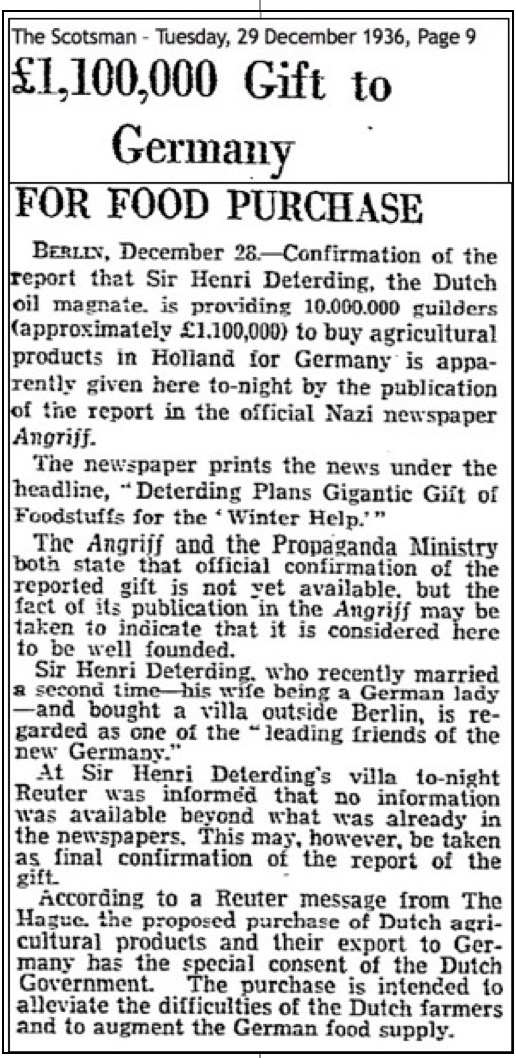
The Scotsman: £1,100,000 Gift to Germany FOR FOOD PURCHASE: 29 December 1936 (Contains confirmation of the report of the gift)137 The Manchester Guardian: £1,000,000 TO BUY FOOD: Helping Germany: SIR H. DETERDING PROVIDES MONEY: Tuesday 29 December 1936,138 Extract £1,000.000 TO BUY FOOD Helping Germany SIR H. DETERDING PROVIDES MONEY The report is published in the official Nazi newspaper “Angriff,” under the headline “Deterding Plans Gigantic Gift of Foodstuff for the “Winter Help.” THE TIMES: “DUTCH HELP FOR GERMANY”: 30 December 1936.139 Extract: Sir Henri Deterding has drawn up a scheme by which the entire surplus of Dutch agricultural products is to be bought and transported to Germany. There it will be sold in marks and the revenue will be handed over to the German Winter Help organization. The Straits Times, 30 December 1936, page 11:140 Extract Sir Henri Deterding And The Nazis. Berlin, Dec. 20. The Dutch oil king, Sir Henri Deterding, is giving 10,000,000 Dutch florins to buy agricultural products in Holland for Germany. The official Nazi organ, Der Angriff, describes the gift as a gigantic one of foodstuffs for “the winter help.”
Sir Henri has long been regarded as one of the leading friends of the new Germany.–Reuters Wireless. SAN ANTONIO EXPRESS: DUTCH SHELL HEAD TO BUY DUTCH FARM PRODUCTS FOR GERMANY: Wednesday 30 December 1936.141 Extracts: DUTCH SHELL HEAD TO BUY DUTCH FARM PRODUCTS FOR GERMANY The rise of a new agrarian party in the Netherlands, dominated by Sir Henri Deterding, may result from the oil magnate’s large-scale purchases of Dutch farm products for Germany, officials here said today. Another result may be preferential treatment for Sir Henri’s oil interests in a grateful Germany, these authorities indicated. Sir Henri, chairman of the Royal Dutch Petroleum Company, a Hollander recently married to a German woman, yesterday announced he was making available 10,000,000 guilders (about $5,400,000) to buy products of Dutch farms – which have had a hard time finding markets- for shipment to Germany, where shortage of foodstuffs is a serious problem. The Argus (Melbourne) Wednesday 30 December 1936 Page 1142 Extract: With the object of assisting Dutch farmers, Sir Henri Deterding has given £1,000,000 for the purchase of farm products for export to Germany. The Advertiser (Adelaide, SA Thursday 31 December 1936 Page 17: Complete Article143 DUTCHMAN’S GIFT TO GERMANY Communism And Trade Barriers Aimed At Australian Associated Pres. THE HAGUE, December 29.
Indicating that his gift of £1,000,000 to purchase produce for export to Germany was aimed at circumventing economic restrictions and communism. Henri Deterding, Director-General of the Royal Dutch Petroleum Co., said today: “The main object of the Communists is to prevent co-operation between nations. They therefore started to create trouble in Spain six years ago, and the result is now daily visible.” Britain, he said, could be thanked for her policy of non-intervention which had prevented greater trouble among other Powers whose further co-operation would be the quickest remedy against infectious Communism. Reviewing the economic conditions obtaining in Holland, Sir Henri Deterding said that the only solution was the diversion of surplus products to a country where they were wanted. Trade restrictions between Germany and Holland could then be safely cancelled. Criticising the present gold policy, Sir Henri Deterding declared that not gold but products of labour would have to serve as the means of exchange. He asked for financial and other support for his scheme under the motto, “Western Cooperation.” Meanwhile 30,000 pigs and 1,000 tons of bacon have already been bought with his gift, and a new industry has been founded at Haarlem. It is expected that Sir Henri Deterding’s scheme will slightly increase the prices of dairy produce in the United Kingdom, of which Holland is a substantial supplier. Australia will undoubtedly benefit to some extent, but the increase in British purchases from individual nations is likely to be small. Australian circles hope that a considerable part of the gift will be devoted to buying Dutch eggs, which strongly compete with Australian eggs. This would be marked assistance and would go far to ensure a successful Australian export season. Version published 31 December 1936 on page 10 of The Sydney Morning Herald.144 SIR HENRI DETERDING’S CAMPAIGN. Reason for £1,000,000 Gift. LONDON, Dec. 30. Sir Henri Deterding, director-general of the Royal Dutch Petroleum Company, and a director of the Shell Transport and Trading Co., Ltd., who has given £1,000,000 for the purchase of Dutch produce for export to Germany, apparently intends the gift as part of the campaign against economic restrictions and Communism. “The main object of the Communists is to prevent co-operation between the nations,” he says. “They therefore started to create trouble in Spain six years ago, and the result is now visible. “Britain can be thanked for her policy of non-intervention, which has prevented greater trouble among other Powers, whose further co-operation will be the quickest remedy against infectious Communism.”Reviewing the economic conditions of Holland, Sir Henri Deterding expressed the opinion that the only solution was the diversion of the surplus products to a country where they were wanted. Restriction on trade between Germany and Holland could then be safely cancelled. He criticised the present gold policy, and urged that not gold but the products of labour would have to serve as the means of exchange. He asked for financial and other support of his scheme under the motto,”Western Co-operation.” Already 30,000 pigs and thousands of tons of bacon have been bought with the gift. AUSTRALIA MAY BENEFIT. It is expected that Sir Henri Deterding’s scheme will slightly increase dairy produce prices in the United Kingdom, of which Holland is a substantial supplier. Australia will undoubtedly benefit to some extent, but the increase In British purchases from individual nations is likely to be small. Australian circles hope that a considerable part of Sir Henri Deterding’s gift will be devoted to buying Dutch eggs, which strongly compete with Australian eggs. This would be of marked assistance at present, and would go far to ensure a successful Australian export season. A new institute has been founded n Harlem, by which a periodical will be issued under the editorship of Dr Dyt, the administrator of Sir Henri Deterding’s large estates in Mecklenburg (Germany). The Tass Agency, Moscow, reports a big decline in Russo-German trade, because of the impossibility of obtaining full value in foreign exchange for goods exported to Germany. The statement is clearly intended to answer French complaints that Russia Is exporting raw materials to Germany for the manufacture of munitions. Official figures show that Russian exports of manganese to Germany fell from 130,000 tons in 1935 to 11,000 tons in the first 10 months of this year.
Reuters report published on page 1 of The Singapore Free Press and Mercantile Advertiser on 31 December 1936:145 SIR HENRI DETERDING EXPLAINS BIG GIFT TO AID GERMANY Sir Henri Deterding, in an interview, said his gift of 10,000,000 florins to buy agricultural products in Holland for Germany was actuated by the necessity of doing away with cumbersome restrictions and helping to restart the free exchange of commodities. The world is starting to enthrone gold as its ruler, he said. That is wrong for the world as well as for gold. Reuter From the book “Hitler, Volume 1” by Konrad Heiden: Publisher Eugen Prager, 1936 – Biography & Autobiography – 388 pages146 Extract from page 224 They showed such exact knowledge that the agency of wire-pullers was immediately suspected, until in 1929 Hitler positively denied any financial connection with the East-Elbe Brown Coal Syndicate. On the other hand, financial connections with Sir Henry Deterding, head of the Koninklijke Shell Oil concern, owner of Russian oil wells confiscated by the Bolsheviks, and the main instigator of the anti-Bolshevik campaign, were never denied either directly or indirectly. Extract from The Aryan Path, Volume 7, Issue 6: Indian Institute of World Culture: Theosophy Co (India) Ltd 1936,147 Extract from page 262 Deterding, Director-General of Royal Dutch Shell, gave funds to the Hitler movement and even French munitions makers contributed to Hitler’s war chest.
1937
Time.com: “GERMANY: Petticoat Philanthropy?” Monday, Jan 11, 1937.148 Extract: Sir Henri, who was knighted by King George V in 1920, has for many years had his chief residence in London’s swank Mayfair, but last week he was sitting in his new house near the German capital and showed signs of developing into a good Berliner. His big Germanic gesture as 1937 opened was to place 10,000,000 Dutch guilders ($5.475,000) at the disposal of Dutch farmers…
Entry in the diary of Joseph Goebbels made on 12 January 1937.149 “Hilgenfeld says WHW Deterding has donated 40 million.” This was a reference to a 40 million Reichsmark donation made by Deterding to the German Winter Help Work, also known as the Winter Fund, a food donation scheme known by the acronym “WHW”. Part of the funds received were diverted by Goebbels for other purposes, for example to build a giant factory for Volkswagen. Background material on the organisation150 indicates that, in the prewar years, one of its largest revenue streams came from donations by companies and organisations, making the Winter’s Fund an important financier of Nazi welfare structures. As previously mentioned, Erich Hilgenfeld151 was a special envoy of Hitler. He was also Chief Director of the WHW, and became head of the associated Nationalsozialistische Volkswohlfahrt/People’s Welfare Organization (NSV) and in 1939, a Brigadeführer in the Waffen-SS.
The Advertiser (Adelaide), Saturday 23 January 1937 page 23152 Extract from page 23 Awaiting Goering’s Return Reports from other sources suggest that while Germany would undoubtedly welcome tentative conversations at present regarding possible economic readjustments, she will not allow any interference with her military Four-Year plan. She may even for that reason refuse Sir Henri Deterding’s offer to buy £1,000.000 worth of foodstuffs from Holland for Germany. Extracts from a New York Times article “Deterding to Distribute More Food in Germany published 8 June 1937:153 Some months ago he spent 10,000,000 florins on agricultural produce that could not be sold by normal means because of clearing regulations. He gave this to the German Winter relief. Sir Henri’s action met much criticism. It was said, for instance, that Germany’s situation was largely caused by her rearmament policy… Ignoring all criticism, the famous oil magnate announced today he would soon devote another large sum to the purchase of agricultural surplus, mainly vegetables, for distribution in Germany. Extracts from a New York Times article published 31 December 1937 under the headline “DETERDING AIDS REICH AS WAY TO BAR REDS”154 Wireless to THE NEW YORK TIMES AMSTERDAM. The Netherlands. Dec. 30.–In a statement appearing in the leading newspapers here, Sir Henri Deterding, chairman of the Royal Dutch Petroleum Company explains his plan to purchase about 10,000,000 guilders’ worth of Netherland cattle and agricultural products for the German food supply.
1938
Extracts from the book “The most powerful man in the world: The Life of Sir Henri Deterding”: By Glyn Roberts155 Extract from page 305. But Deterding was impressed, and the Dutch press reported that, through the agent Georg Bell, he had placed at Hitler’s disposal, while the party was “still in long clothes,” no less than four million guilders. This huge subsidy came at a decisive moment in the history of the growing Nazi movement. Let there be no doubt that, had it not been found, the whole racket might have collapsed and the history of Germany and of Europe might have had a different complexion. Extracts from page 317 The Daily Telegraph quoted the Vienna Arbeiter Zeitung which said that Bell was liaison officer between the Hitlerites and a big international magnate who had contributed much money to the Nazi cause. “Last year Dr. Bell with the Hitlerite leader Rosenberg met the magnate in London, and big credits for the Nazis followed.” The German writer Johannes Steel, who had had unique opportunities of studying from the inside the growth of the Nazi movement, its true aims and the sources of its financial and diplomatic backing, gave evidence, though his name was not used. Steel had worked as director of Germany’s Economic Intelligence Service, and knew all about the Nazis and their friends. He offered to explain to this body exactly where the Fascists who controlled Germany were getting money from in England; the man whose part he wished to reveal was Sir Henri Deterding. Extract from page 320 Sir Henri Deterding did not layoff the Nazis; he did not cease to praise their aims and achievements in public and in private, and he did not cease to assist them financially. Extract from page 322 The Nazi “bulwark against Bolshevism” had to be kept up; in 1931 reports were denied of a Deterding loan of £30,000,000 to be made in exchange for a petroleum monopoly. In the Presidential election of 1932, in which the two leading candidates were Adolf Hitler and Paul von Hindenburg, Deterding was accused, as Edgar Ansell Mowrer testifies in his “Germany Puts the Clock Back, of putting up a large sum of money for the Nazis on the understanding that success would give him a more favored position in the German oil market. On other occasions, figures as high as £55,000,000 were mentioned. Extract from page 322 running on to page 323 Sir Henri knew that Germany was on the brink of starvation, that wages were low and nutrition lower; he knew that unless every good friend of the Nazi regime was prepared to help to prop it up, it would very soon collapse in the face the wrath of the working people of Germany and the administrative incompetence of its heads. Food was the crux of the problem. Germany had little, and much of what she had was of poor quality and frequently made of chemicals or substitutes. Holland, on the other hand, had a large surplus. Extract from page 323 Sir Henri had a grand idea. All Holland’s agricultural surplus, itself at times an economic problem, should go to Germany, into the hands of the German Government, which would be that much further away from bankruptcy and the sack. Who would pay for it? Why, he would. It was worth it. Sir Henri had always been prepared to payout real money to prevent Bolshevism from making another conquest in Europe. His initial contribution to this scheme was quoted as being $5,500,000. Extract from page 324 The Nazis were doubtless delighted to receive an initial delivery of the bacon of thirty thousand pigs; and soon much more followed. One report spoke of “millions of tons” of bacon. Seven thousand railway wagons were used in the first immense delivery. Book reviews of “The Most Powerful Man in the World” in 1938. Information from a pdf of a New York Times book review by P.W. Wilson of “The Most Powerful Man in the World” by Glyn Roberts published 12 June 1938:156 Review based on information in the book states that Deterding married a German and became pro-Nazi and according to reports that Roberts believed to be trustworthy, gave a large sum to the Hitler movement to obtain a favoured position in the German oil market.
Extracts from A.F.P. book review of the Glyn Roberts biography of Sir Henri Deterding - “The Most Powerful Man in the World” - published on Sunday 12 June 1938 by The Milwaukee Journal under the headline: “Sir Henri Deterding Is the Arch-Villain in This Biography”:157 Two years ago Sir Henri Deterding, the Anglo-Dutch oil king and head of the Royal Dutch-Shell Group, retired as director general of the Royal Dutch unit, at the age of 70, though he remained on the board of directors. In his semiretirement, Sir Henri will feel flattered that his dear enemies, the leftists, still regard him as “the most powerful man in the world,” and they charge him with financing Hitler, admiring Mussolini and generally propping up “decadent capitalism: all over the world. Sir Henri is not merely a fascist, he is the cause of fascism in others, the paymaster and wet nurse of a dictatorship. Extracts from a book review of the Glyn Roberts biography of Sir Henri Deterding - “The Most Powerful Man in the World” - published on Sunday 12 June 1938 by The Galveston Daily News under the headline: “BIG OILMAN” A leftist Life of Sir Henri Deterding of Royal Dutch Shell:158 The author believes that the enormous financial and political power wielded by a really big-shot capitalist like Deterding is a very dangerous influence in world affairs – and particularly when such power is used, as Deterding, according to the author, used it in the post-war years to organize the forces of fascism in Europe, to wage an unremitting propaganda campaign against Soviet Russia and to subsidize the nazi movement in Germany. Besides subsidizing the nazis in the hope that Hitler will launch a crusade against Soviet Russia, Deterding, says the author, also admired Mussolini, sides with Franco, has his doubts about democracy, believes that youth should be “disciplined” and all “idlers” shot. As a businessman, his life has been an astonishing success, and his achievements in building up gigantic financial structures have been prodigious. The author readily admits all this, but grows alarmed because Deterding is on the fascist side – as if such a man could be on any other side! – and concludes his book by saying: “And we have seen the world which he, in many ways the most powerful man in it, has produced.
BOOK REVIEW BY JOHN B. CLARK OF MERCER UNIVERSITY159 of the book “The Most Powerful Man in the World. BY GLYN ROBERTS. (New York: Covici-Friede. 1938. Pp. 448. $3.00.) EXTRACT Deterding, though pretending to remain free from politics, has always been a political factor. His has been a crusade for capitalism. He has poured millions of dollars into the hands of Franco and the Fascist cause in Spain; has aided Hitler and the Nazi program in Germany; has admired Mussolini; and has given unstinted financial support to White Russia. All of the above information was published prior to the death of Sir Henri Deterding 4 February 1939 when he had the opportunity and ample funds to take legal action if defamed. 1939 Extract from the 1939 book “ARMIES OF SPIES”: By JOSEPH GOLLOMB160 George Bell, a Scotch engineer, was also a minor figure, but he was the agent of Sir Henri Deterding, the British oil king. Sir Henri and Adolf Hitler have had in common a plan to help themselves to Soviet Russia’s oil fields. Their alliance went back to the time when Hitler had not yet become Chancellor but was first getting there. Sir Henri, sensing an ally, contributed 4,000,000 gulden to Hitler’s growing party. The Alliance was so unsavoury to a large public and the contribution so heavy that Sir Henri used an intermediary the little known George Bell. 1940 Extract from page 21 of the WINNIPEG FREE PRESS, published Wednesday 12 June 1940 under the headline “FIFTH COLUMN”161 It had been said that powerful financial groups with Canadian connections had contributed to the Nazi movement in Germany, he said. Among those was Sir Henri Deterding of the Shell Oil company. Mr Caldwell emphasized he was dealing only with established facts.
The book “War in the Twentieth Century”: By Willard Waller162: Extract from page 350 The British oil magnate, the late Sir Henri Deterding, contributed to Hitler’s campaign funds because he saw in the Nazi movement an instrument to attack the Soviet Union and to regain his petroleum wells that the Russians had confiscated. Collected Works of Michal Kalecki: Volume VI: Studies in Applied Economics163 FROM PAGE 173 Subsequently, apparently not unfounded revelations have surfaced that Deterding had given large subsidies to Hitler who more than once has extended his offer in the role of the future conqueror of the Soviet Union in the services of international capitalism. An integral part of Hitler’s programme is forcing the separation from the USSR of the Ukraine and the Caucasus with its oilfields. Deterding’s subsidies for Hitler must have been large since, not content with these lofty dreams about the future triumphs of German arms, Deterding is said to have received much more concrete pledges from Hitler: the Nazi leader supposedly promised that after he comes to power, he will give Deterding the German oil monopoly in exchange for a payment of £1.5 million and a 20% share in the profits of the monopoly. 1942 Extract from the book “PATENTS FOR HITLER” by Günter Reimann164 Extract from page 22 Sir Henri Deterding had built up Royal Dutch Shell as his private world empire. He was respected and protected by foreign governments as the sovereign manager of that gigantic enterprise. He was interested in discovering and fostering those forces which would eliminate once and for all the danger of social or colonial revolutions. Therefore he was one of the earliest financial backers of the Fuehrer – long before Hitler came to power. In later years, when Nazi Germany rearmed, he was an ultra-appeaser. He made great donations (at the expense of Shell) to the Nazis, and he personally offered to supply the Third Reich with foodstuffs and vital raw materials, the acquisition of which was to be financed by foreign credits which he would undertake to arrange. On 25 October 1942, The Los Angeles Times published a review by Conrad Rank of a book authored by reporter Marquis Child’s, entitled: “I WRITE FROM WASHINGTON”.165 Child’s is described in the review as “trying to be eminently fair” in his appraisal of public figures. During his research, he had discovered “startling facts”, some relating to Shell and Sir Henri. Child’s said in his book: “…Sir Henri Deterding of Royal Dutch Shell was not himself innocent of working with Hitler. Sir Henri backed him with a huge sum when the Nazi party was about to fall; and it was the oil man’s objective to get Hitler to attack Russia so that Sir Henri might take over the Baku oil fields.” 1943 The Book “Way for America” by Alexander Laing166 EXTRACTS FROM PAGE 241 & 242 Edgar Ansel Mowrer published in 1933 a book entitled “Germany Puts the Clock Back.” In it he said (p. 146), “Sir Henri Deterding was accused by unfriendly Germans of having put up a considerable sum for the 1932 presidential campaign in the hope (or on the promise?) of being granted an oil monopoly in the Third Empire.” FROM PAGE 242 Deterding made it plain that he too considered Hitler’s dictatorship a stabilizing influence which could join in an orderly removal of the blunders of Versailles. If he was secretive about his early backing of the Nazis, later he came out as an earnest advocate of a scheme which greatly eased Hitler’s problems. Deterding put his own estate manager in charge of the Western Cooperation plan, under which benevolent Dutchmen bought up the Dutch food surplus and gave it to German organizations. Public acknowledgment of Deterding’s own first contribution to the scheme placed it at a sum which converts to more than five million dollars. This was after Hitler and his henchmen had committed some of their most loathesome brutalities.
From page 244: He is alleged to have spent millions helping Hitler to power. Whether he did or not, he expressed over and over again his admiration for Fascist methods and for a kind of international cooperation on his own terms. PAGE 245 Sir Henri was an unashamed admirer of Fascism. PAGE 247 Recalling these circumstances, ask yourself whether the opinion of the “most powerful man in the world” -the praiser of Mussolini and backer of Hitler-the announced hater of the Soviets–the autocrat of the second largest oil company in existence-had a decisive effect upon the course of the British government. PAGES 249 & 250 In desperate recognition of their mistake in backing the more dangerous of two tyrants, most Britons began to oppose the Hitler regime as much as they dared. Sir Henri then indicated where his own sympathies still lay by moving his headquarters from the house near Windsor Castle to another which he had recently purchased between Berlin and Rostok. He was buried on his German estate. The bishop who delivered the funeral oration said (according to the New York Times) that the oil man had fought Bolshevism with the “boldness of a Napoleon and the will-power of a Cromwell.” Placing the last wreath, an official emissary added, “In the name of Adolf Hitler, I greet you, Henri Deterding, the great friend of the Germans.” From the book “Maxim Litvinoff: Arthur Upham Pope”:167 Extract from page 173 …influential figure in the background was the rabidly reactionary Sir Henry Deterding, later a friend of Adolf Hider, who beyond doubt lavishingly financed a good deal of anti-Soviet propaganda.
1944
From the book “The Gentleman Talk of Peace”: By William B Ziff:168 Extract from page 337. The German Fuehrer had risen to power with the indirect assistance of powerful reactionary British groups. Industrial giants such as Henri Deterding, head of the vast Shell Oil combine, and the immensely wealthy Guinness family, are said to have contributed heavily to the Nazi war chest.
1945
Extract from a New York Times article published 19 October 1945 under the headline: U.S. FIRMS FUELED GERMANY FOR WAR:169 Extract Standard Oil and the Anglo-Netherland Royal Dutch Shell group also aided I.G. Farben in 1934 and 1935 to purchase large quantities of mineral-oil products, the report said. These products, including airplane benzine and lubricants, were bought for a market price of $20,000,000 and stored as reserve stocks.
From the book “The Plot against the Peace: A Warning to the Nation!”:170 Extract from page 100 “*Other international financial backers of Nazism in its early years included Sir Henri Deterding, Anglo-Dutch chairman of the oil trust Royal Dutch Shell;”
1946
From The New York Times article: “Propaganda Success in Britain Vaunted by Rosenberg to Hitler”: 10 January 1946,171 Extracts “NUREMBERG, Germany, Jan. 9- One of Alfred Rosenberg’s reports to Adolf Hitler on his work in winning friends for Nazism in foreign countries came to light today”: Rosenberg also told Hitler that “a firmer bond” had also been established between Rosenberg’s British division and Sir Henri Deterding, the oil magnate, and his associates’ From the book “Earth Could Be Fair: A Chronicle”: By Pierre Van Paassen:172 Extracts from pages 393 and 394 That fellow Hitler is the God-given leader Europe has needed for a long time. He is going to straighten things out a little. To begin with, he will get us the Baku oil fields back. That’s as certain as tomorrow’s sunrise. Deterding and Colijn are supporting him, and every decent businessman in the land. 1949 From the book “THE LIFE AND DEATH OF THE LUFTWAFFE”:173 The book makes reference to a portrait found in the country home of Sir Henri Deterding, signed by Hitler and containing the following inscription: “Sir Henry Deterding – in the name of the German people, for your noble donation of a million Reichsmarks.” 1954 From the book “Tycoons & Tyrant”:174 Extract from pages 110 and 111: It is generally believed that Sir Henry Deterding, the Dutch oil king, who owned an estate in Mecklenburg and supported all anti-communist movements, helped Hitler in a big way. It is alleged he gave as much as ten million marks in the course of the years. I have been unable to find concrete evidence to prove this point. Footnote on page 111:
Walter Gorlitz and Herbert A. Quint in their Adolf Hitler-eine Biographie (Stuttgart, Steingruben Verlag, 1952), p. 279, merely refer to Deterding as one of a number of financial backers.
1957
From the book “German-French Unity, Basis for European Peace.”175 Extracts From page 113 More illuminating than Dodd’s entry in his diary is an entry in a German diary, according to which General von Schleicher, while Chancellor, said early in January, 1933: Hitler must be, arrested, his Party dissolved and outlawed, the whole scandal of the Nazis’ revenues brought to light, their connection with the armaments industry abroad, with Deterding, with Ivar Kreuger made public. Pages 114 & 115 In the early thirties, Deterding regarded the struggle against the Communists as “the only task left for him to accomplish.” 24, He was, thus, a natural ally of Adolf Hitler. In 1932, the Netherlands’ press reported that the Dutchborn Sir Henri had subsidized the NSDAP with 4,000,000 gulden, a statement that was allegedly never denied. Immediately after the Reichstag fire, February 27, 1933, Bell brought Dr. Gerlich several important documents, one of which was a contract of the NSDAP, represented by Chief-of-Staff Roehm, with the English-Dutch petroleum King Deterding, concerning the financing of the SA in the years before the seizure of power, against the assurance to favor his oil interests after the seizure of power. Page 116 Deterding had also been a good friend of Hermann Göring ever since the latter’s early days. It is noteworthy that E. A. Mowrer heard “unfriendly Germans” accuse Deterding of having put up a considerable sum for the 1932 presidential campaign in the hope (“or on the promise?” Mowrer inserted) “of being granted an oil monopoly in the Third Empire.” When Sir Henri Deterding died in February, 1939, the German press was instructed not to mention that he had been a sincere friend of Nazi Germany. Extracts from page 117 If Sir Henri was thought liberal enough to give the weak British Fascist leader two million marks, it may be safety concluded that his contributions over the years to the Hitler movement, infinitely more important to him, comprised a good many millions of marks. He may surely be considered the largest single foreign financial backer of the NSDAP. One of these was Fritz Thyssen, who also mentioned to Mr. Emery Reves, the editor of his book I Paid Hitler ( New York, 1941), that Sir Henri Deterding was one of the foreigners who gave financial aid to Hitler. Page 180 These principles decreed by the victors in 1945 and 1946, lead logically to the conclusion that, for instance, Viscount Rothemere as an influential moral supporter, and Sir Henri Deterding as an outstanding financial supporter of the Hitler movement were Offenders, ranking as Activists, and would have been liable to the severe sanctions under Article IX. 1964 From the book “The Gestapo: a history of horror”:176 Page 29 In fact the S.S. settled bloody accounts, liquidated their adversaries and the accomplices of the old days who had become dangerous. They murdered the engineer, George Bell, who had acted as intermediary in the financial transactions between Hitler and Sir Henri Deterding: 1975 From the book “THE SEVEN SISTERS: THE GREAT OIL COMPANIES AND THE WORLD THEY MADE”177 Page 96
His influence on the company was erratic and as one Shell veteran recalls: ‘Deterding’s interventions were like thunderstorms; suddenly flattening a field of wheat, while leaving other fields un-scathed.’ The stately managers of Shell began to have the worrying impression that their Director-General was going mad, and still worse, going pro-Nazi. Page 97 He died six months before the outbreak of war: memorial services were held in all Shell offices in Germany and Hitler and Goering both sent wreaths to the funeral on his estate. 1979 Extracts from the book “WHO FINANCED HITLER” (The Secret Funding of Hitler’s Rise to Power): Published in 1979:178 Reference source for pages 319, 179 & 512 below From page 319 Deterding was one of the wealthiest men in the world. His clandestine meetings with Hitler’s representative gave little indication of the plots, intrigues, and secret transfers of money that were taking place between Deterding and Hitler. From page 323 The Dutch press stated that Deterding sent to Hitler, through Georg Bell, about four million guilders. Some said Sir Henri gave the Nazis money in exchange for their agreement to give him preferred standing in the German oil market when they came to power. In 1931, it was reported that Deterding made a loan of £30 million to Hitler in return for a promise of a petroleum monopoly. Some claimed the loan was as much as £55 million. Louis Lochner, former foreign correspondent and authority on the relation between Hitler and big business, mentioned an alleged “ten million marks” contribution by the Dutch oil lord to the Nazis. With so many sources agreeing on the matter, there can be little doubt that Deterding financed Hitler.
1983
From the book “The Windsor Secret - - New Revelations of The Nazi Connection”:180 Extracts from page 42: In mid-1933 Rosenberg made a second and last visit to Britain. He spent an entire weekend at the palatial home at Ascot of Sir Henry Deterding. Several newspapers gave reliable accounts of the visit. Reynolds Illustrated News wrote: “In the light of the present European situation, this purely private talk between Hitler’s foreign adviser (Rosenberg) and the dominant figure in European oil politics is of profound interest.” The meeting between Rosenberg and Deterding was significant because Deterding was one of the wealthiest men in the world, and it is a fact that in the 1930s he loaned Hitler between 30 and 55 million pounds. His clandestine meetings with Rosenberg, though, gave little indication of the plots, intrigues, and secret transfers of money that were occurring between Hitler and Deterding.
1984
Annual, Volumes 19-20: Obshtestvena kulturno-prosvetna organizat͡ sii͡ a na evreite v Narodna republika Bŭlgarii͡ a. T͡ Sentralno rŭkovodstvo: Published 1984.181 From page 165: According to the American journalist and historian P. Lockner, Henry Deterding alone had subsidized Hitler with 10,000,000 marks. (Henry Deterding was an English Petroleum tycoon.) From the book “The Blood of His Servants”:182 On page 63, Deterding is described as “a maniacal genius.” Extract from page 128 Ever since Sir Henry Deterding’s death in Berlin in 1939, the ties with Shell and its banker Mannheimer had dissolved. Even more, now that the war was going badly for the Nazis, Shell wanted to disassociate itself from Deterding’s fanatic devotion to Hitlerism.
1985
From Intercontinental press publication: 1985.183 Extract from page 325 One of Hitler’s earliest foreign financial backers was Sir Henri Deterding, head of the giant Royal Dutch/Shell oil company.
1988
Toward an American Revolution: Exposing the Constitution and Other Illusions:184 Extract from page 129 Sir Henry Deterding, Chairman of Royal Dutch Shell, pointed out in 1932, the “Nazis are a great stabilizing force which would come in handy against Soviet Russia.” 1992 Extract from the book “The Prize” By Daniel Yergin185 From page 369: For there was a risk that the Group could pass under the Nazi sway. The heart of the problem was Henri Deterding, the grand master of the company. He had continued to dominate the Group through the 1920s. “Sir Henri’s word is law,” observed a British official in 1927. “He can bind the Board of the Shell without their knowledge and consent.” In the mid-1930s, as he entered his seventies, Deterding had developed two infatuations. One was for his secretary, a young German woman. The other was for Adolf Hitler. Page 370 Deterding died in Germany in early 1939, six months before the war began. Strange and deeply disturbing rumors immediately reached London. Not only had the Nazis made much of his funeral, but they were also trying to take advantage of the circumstances of his death to gain control of the Royal Dutch/Shell Group.
From the book: “The Mexican petroleum industry in the twentieth century”:186 EXTRACT FROM PAGE 97 Accordingly, Deterding-who was certainly sympathetic to fascism–channeled cash to Hitler (“thanks to English money Hitler conquered Germany”), in the hope that Hitler would revalidate Royal-Dutch’s lost Caucasian concessions Extract from the book “George Bush: The Unauthorized Biography”:187 From page 47 Shell’s chairman, Sir Henri Deterding, helped sponsor Hitler’s rise to power, by arrangement with the royal family’s Bank of England Governor, Montagu Norman.(3) From the book “A CENTURY OF WAR”: “ANGLO-AMERICAN OIL POLITICS AND THE NEW WORLD ORDER”:188 From page 83 running on to page 84 The final London visit of Alfred Rosenberg was in May 1933, this time as one of the inner figures in the new Hitler government. He went directly to the country home in Buckhurst Park in Ascot of Sir Henri Deterding, the head of Royal Dutch Shell and arguably the world’s most influential businessman. According to English press accounts, the two had a warm and eventful discussion. Rosenberg had first met Deterding during his 1931 London trip. Royal Dutch Shell had intimate contact with, and provided support for the German NSDAP. Though the details were kept secret, reliable British reports of the day were that Deterding had provided substantial financial support to the Hitler project in its critical early phases.
1993
New York Times: Review/Television; The Epic Of Oil, Catalyst Of Conflict:189 Extract from the article: It concentrates especially on the unlikely partnership, out of which was born Royal Dutch Shell, between Marcus Samuel, the Jew from the East End of London who became the Lord Mayor of London, and Henri Deterding, the dashing Dutch oil man who turned into a Nazi supporter in his old age. See related article about the same PBS documentary published under the headline: “Film of Royal Dutch Shell founder Sir Henri Deterding giving a Nazi salute”190 The New York Times published an article in August 1933,191 reporting that the international financier J.P. Morgan had taken exception to an allegation in the Steel book, “Hitler as Frankenstein,“ that his firm had contributed to Nazi funds. The book was temporarily withdrawn and slip inserted stating: “The publishers are informed that this statement is without the slightest foundation in fact and that neither Mr Morgan nor the firm of J.P. Morgan & Co, nor any individual partner of the firm every make any contribution to Hitler or any other German organization.” There is no evidence of which I am aware of Deterding or Shell taking any such action in response to this or any other book on similar grounds. With regard to J.P. Morgan, many allegations about the firms’ alleged pandering to the Nazis have continued to be published over the years, up to current times; just Google “J.P. Morgan and the Nazis” on the web and within “Google Books”.
1997
From the book “The Trial of the Germans:192 Page 229 Some support of Hitler came from foreign countries. The Dutch oil magnate Henri Deterding, who had an estate in Mecklenburg, made sizable contributions. From the book “A Century In Oil”: The ‘Shell” Transport and Trading Company 1897-1937 by Stephen Howarth: Published in 1997,193 Page 187 Deterding had become increasingly right-wing, bordering, some said, on the megalomaniac. The Nazis, eager even after his death to exploit the publicly-avowed support of this world-famous individual, virtually hijacked his funeral: Field Marshal Goering, chief of the German air force, sent a wreath; so did Hitler… From an article by Andrew Rowell published on 15 November 1997 by The Guardian under the headline: “Unloveable Shell, the Goddess of Oil”:194 “After it merged in 1907 with its rival Royal Dutch, the Royal Dutch Shell company was formed; its first chairman was the Dutchman Henri Deterding. By the 1930s, Deterding had become infatuated with Adolf Hitler, and began secret negotiations with the German military to provide a year’s supply of oil on credit. In 1936, he was forced to resign over his Nazi sympathies.”
1998
From the book: “Hitler+Geli“240 According to information on pages 187 and 188, Ernst Rohm, head of the SA, entered into a secret agreement with Sir Henri Deterding, described as “an oil tycoon with a controlling interest in Royal Dutch Petroleum and the Shell group.” From an article published by The Observer: Oil behemoth that must evolve: 20 December 1998 (Page 34)195 Unfortunately, Deterding was also an authoritarian who was strongly attracted by the ideas of first Mussolini and then of Hitler’s Germany. The scandal forced Deterding to resign in 1936. 2000 Extract from the book “DOING BUSINESS WITH THE NAZIS”:196 From page 149 The American consul in Hamburg reported in 1934 that Deterding, because of his fear of the Soviet Union, was favourably inclined toward the German government as a necessary safeguard against the spread of communistic ideas in western Europe. The consul added: Sir Henri had contributed fairly large sums to the National Socialist treasury before the advent of the Party into power and since Herr Hitler’s assumption of the Chancellorship; he had offered to supply the Reich with all their oil requirements in return for payment in blocked reichsmarks …
Extracts from a book by F. William Engdahl “Anglo-American Oil Politics and the New World Order” published 21 February, 2001:197 EXTRACT FROM PAGE 100 OF THE BOOK On January 30, 1933 Adolf Hitler became Chancellor of the Reich. The final London visit of Alfred Rosenberg was in May 1933, this time as one of the inner figures in the new Hitler government. He went directly to the country home in Buckhurst Park in Ascot of Sir Henri Deterding, the head of Royal Dutch Shell and arguably the world’s most influential businessman. According to English press accounts, the two had a warm and eventful discussion. Rosenberg had first met Deterding during his 1931 London trip. Royal Dutch Shell had intimate contact and support to the German NSDAP. While the details were kept secret, reliable British reports of the day were that Deterding had provided substantial financial support to the Hitler Project in its critical early phases. 2002
From the book “Hidden Agenda: How the Duke of Windsor Betrayed the Allies”:198 Extract from pages 19 & 20 This is significant because Deterding was one of the wealthiest men in the world, and it can hardly be a coincidence that after Rosenberg’s visit in the early 1930s, Deterding loaned Hitler almost £55,000,000. From the book “Fathoming the Holocaust: A Social Problems Approach”:199 Extract from page 34 The party also solicited money from beyond German borders. Hitler himself went on several fund-raising tours in Switzerland, Austria and Czechoslovakia. Italian dictator Benito Mussolini had his government provide support. Through Rosenberg the party received money from wealthy British oilman Sir Henri Deterding.
Extract of a book review of “Sir Henri Deterding and Royal Dutch-Shell: Changing Control of World Oil 1900-1940”:200 When he died early in 1939 and his wife, against family wishes, had him buried in that country, the regime exploited the burial as a propaganda coup, and the Foreign Office in London incorrectly feared lest his Shell shares might fall into German hands. 2003 From the book “The Hitler/Hess deception: British intelligence’s bestkept secret of the Second World War”:201 Extracts from pages 206 & 207 After meeting the persuasive Rosenberg, Deterding would loan Hitler the enormous sum of £55 million. 2005 From the book “The Weimar Republic”:202 Extract from page 115 Germans in foreign countries, and some magnates such as Ford, Deterding and Kreuger, provided the NSDAP with large sums, partly from ideological motives (anti-Semitism) and partly from political and economic calculation. 2006 From the book “Energy for the 21st Century: A Comprehensive Guide to Conventional and Alternative Sources”:203 Extracts from page 156 Deterding became a Nazi sympathiser because of their determination to rip communism out root and branch. Deterding would not be the only industrialist, statesman, monarchist, or church leader to support the Nazis for this reason. The board of directors removed Deterding from his position in 1936 by forcing him to retire, and he died six months before the war started. 2007 There is also a considerable volume of information of the Shell/Deterding financial support for Nazi Germany in the “History of Royal Dutch Shell, volumes 1 to 3,” published in 2007. 2008 Extract from a review of F. William Engdahl’s book “A Century of War” by Stephen Lendman204 The Weimar government was weak, the scheme was to topple it, and it made Hitler Reichschancellor on January 30, 1933. On August 2, 1934 he seized absolute power as Fuhrer. British interests backed him, Royal Dutch Shell financed him, and the Bank of England “moved with indecent haste to reward” him with a vital line of credit. Information from a book published in 2008 “The Nazi Hydra in America: Suppressed History of a Century: Wall Street and the Rise of the Fourth Reich”205 According to this book, Johannes Steel testified during an inquiry to Deterdings financial support for the Nazis. The book also says that Deterding made a 20 million pound loan to Hitler: Extracts from pages 48/49 “At the inquiry into the Reichstag fire, Johannes Steel, a former agent of the German Economic Intelligence Service, testified to Deterding’s financial support for the Nazis. The Dutch press reported that Deterding had given Hitler about 4 million guilders. By the 1930s, Deterding began secret negotiations with the German military to provide a year’s supply of oil on credit. In 1931, Deterding made a 20 million pound loan to Hitler, allegedly for a promise of a petroleum monopoly once the Nazis were in power. In May 1933, Alfred Rosenberg, Hitler’s representative, met with Deterding, confirming the close link between big oil and the Nazis. 2009
From the book “Shadow Rulers: The Euro-American Trojan Horse”:206 Page 401 Another Bank investor that came aboard the Hitler boat was Sir Henry Deterding. Head of Royal Dutch-Shell Oil, whose motives, according to Marrs, arose from the Fuhrer’s Mein Kampf disclosures of a plot to regain the oil field assets of Baku, Grozny and Maikop, through the subjugation of Russia.
Publisher: iUniverse.com (11 Oct 2009) 207 pages: ISBN-10: 1440122962 ISBN-13: 978-1440122965
2010
From the book “Wall Street and the Rise of Hitler”:208 Extracts from pages 101 and 102 There is circumstantial evidence that Deterding was pro-Nazi. He later went to live in Hitler’s Germany and increased his share of the German petroleum market. So there may have been some contributions, but these have not been proven. (The author, Mr. Sutton, had apparently not seem some the evidence accumulated herein, for example in the form of contemporaneous news reports of Deterdings huge donations of food to Nazi Germany while he was a Shell director seeking a monopoly position in the German petroleum market.) 2011 From Fortune Magazine, an article by Christian Stadler “5 ways to keep your company alive”:209 Published 7 March 2011.
In the years before World War II, Shell was very much a one-man-band led by Sir Henri Deterding. Under Deterding’s firm control, the group prospered but also flirted with disaster as he saw Adolf Hitler as the man most likely to preserve Europe from Communism. Luckily for Shell, Deterding retired in 1936 before he could make any disastrous commitments. In fact, as previously pointed out a number of times, Deterding remained a director of multiple companies within the Royal Dutch Shell Group until the day he died in February 1939. And the evidence shows that he did make spectacular donations to Nazi Germany reported around the world. Shell funded adverts in a Nazi Newspaper, Volkischer Beobachter.210 Quote from page 478, History of Royal Dutch Shell Volume 1: 1890 -1939 Even before Hitler’s appointment as Chancellor, Deterding’s fervent anticommunism and opinions about general economic policy had received favourable treatment in the Volkischer Beobachter, the Nazi newspaper which also sported conspicuous advertising for Shell products.
Cyrano article reporting on Funeral of Sir Henri Deterding (translated from French to English)211 Deterding, the financier of Hitler Sir Henri Deterding, the tycoon of the oil industry, Anglo-Holland, had a fine funeral. All the press praised, appropriately, the great captain of industry, the tycoon and financier of an Almighty City. But there is one aspect of his life that went unspoken: Sir Henry Deterding was one of Hitler’s financial secrets. On many occasions, he made huge sums available to the German Führer. Only recently – in 1937 – he made a donation of 200 million francs to the Hitler’s government. Sir Henry was a passionate admirer of Hitler, with whom he had frequent interviews. His covert mission, in favour of the Reich, was to improve business relations with Britain, and was of great importance. It explains some of England’s complacency towards Hitler. The Fuhrer has not been ungrateful. On the death of Sir Henri Deterding he ordered expressions of sympathy. His special envoy, Hilgenfeld, laid a beautiful wreath at the Tomb of the potentate of Royal Dutch, saying: On behalf of the Fuhrer Adolf Hitler, I salute you Henrich Deterding, great friend of the Germans A monument will be erected in Mecklenburg, to Sir Henry, and will bear the simple inscription: A friend ( from / of / to ) Germany Flag, no flag TWO CARTOONS Heading on first cartoon: TEGEN OORLOG EN FASCISME (AGAINST WAR AND FASCISM):212 A young Dutchman, Marinus van der Lubbe, was found guilty of starting the Reichstag fire213 which took place in 1933 and was executed in 1934. The blaze was widely believed to be a result of an international conspiracy – provocative arson – involving Deterding, Hitler and Johannes Bell. Heading on second cartoon: “VAN DER LUBBE’S MEDEPLIGHTIGEN (VAN DER LUBBE’S ACCOMPLICES):214 All three – Deterding, Hitler and Johannes Bell – were depicted as accomplices in the Reichstag fire. Both cartoons made it plain that Deterding was Hitler’s paymaster. There is no evidence that Sir Henri, then Director-General of Royal Dutch Shell, took issue with these assertions. Both cartoons, from the International Institute of Social History, can be viewed on page 477 of “A History of Royal Dutch Shell: Volume 1”: The following extracts come from the same source. Extract from page 483 The grand gesture Deterding made after his retirement illustrates how he liked to use his money. In December 1936 he donated, with much fanfare, 215 million guilders from his personal fortune to set up a fund for buying up surplus foodstuffs in the Netherlands and selling them in Germany, purportedly to ease the plight of Dutch farmers and German consumers, equally hit by the trade barriers and exchange restrictions between the two countries. The proceeds of this deal would be donated to the Nazi charity Winterhilfswerk. Extracts from page 485 Moreover, Deterding was widely reported as making rash promises to German officials. In June 1934, during the negotiations between the oil companies and the government over bulk installations, the British Ambassador to Germany, Sir Eric Phipps, heard information that Deterding had promised Hitler to have the Group supply one year’s worth of products on credit to Germany should its economic situation become desperate. No records corroborating Sir Eric’s information have been found in the company archives. However, Rosenberg noted in his diary that he had made a deal with Deterding in May 1934 that the Group would stock one million tons of oil products in underground tank farms built by the Group, only to see the transaction founder on red tape in German departments. Whether true or not, the story reached Deterding’s board colleagues, feeding a nagging suspicion about the soundness of his judgement.
Notes
117. Information from pages 481 and 482, “A History of Royal Dutch Shell: Volume1” ↩
118. Military Tribunals Document from the Nuremberg War Crimes Trials. This document United States of America Against Krauch and Others (Case VI). Part 1. See index page and page marked as “14.” “Krauch” is Professor Dr. Carl Krauch, head of a section at I.G. Farben later given key roles in the German government. See page marked “23” ↩
119. Link to pdf of an Associated Press report published by the New York Times on 18 April 1932 ↩
120. Evidence from Dutch Newspaper “Limburger Koerier”. The quoted text printed in red and associated receipt and newspaper article are all displayed on page 480 of “A History of Royal Dutch Shell Volume 1” ↩
121. Link to Wikipedia article: “Adolf Hitler” - see section “Appointment as chancellor” Source 1 ↩
122. Information from page 470 of “A History of Royal Dutch Shell: Volume 1” ↩
123. Link to shellnews.net webpage containing a number of pages, including pages 22, 23, 46, 47, 87, 88, 89, 90, 91, 92 and 93 from the book “Hitler As Frankenstein” published by Wisart & Co in 1933. ↩
124. Link to Wikipedia article “Johannes Steele” Source 1 ↩
125. Link to royaldutchshellplc.com webpage containing page 4 of Stevens Point Daily Journal published Friday, 1 December 1933 and the article: “Ex-Nazi Member ‘Opens’ Mystery of Hitler Finances” ↩
126. Link to shellnews.net webpage containing preliminary pages and page 114 from a book by Edgar Mower first published in 1933 by Penguin Books under the title: “GERMANY PUTS THE CLOCK BACK” ↩
127. Extract from page 99 of the book published in 1934 “The Second World War” authored by Johannes Steel. ↩
128. Link to royaldutchshellplc.com article “The Second World War by Johannes Steel” published by The Daily Gleaner newspaper on Thursday 8 November 1934 Source 1 ↩
129. Link to shellnews.net webpage containing pdf copy of the publication by Quincy Howe published in 1934 by Robert M McBride and Company in USA under the title: “WORLD DIARY 1929 - 1934” ↩
130. Link to a royaldutchshellplc.com webpage containing an article published on page 2 of The Singapore Free Press and Mercantile Advertiser on 15 December 1934 under the headline “Petrol Monopoly” ↩
131. Link to royaldutchshellplc.com webpage containing an article published by The Port Arthur News Editorial page (page 4) on 13 January, 1935 under the headline: Sidelights on Foreign Affairs” ↩
132. Link to royaldutchshellplc.com webpage containing a Associated Press article published Monday 11 February 1935 on page 5 of The Titusville (PA.) Herald under the headline: “Oil Interests Are Worried” ↩
133. Link to google.com search webpage containing an article published on page 4 of the Meriden Record on 13 September 1935 under the headline “Europe’s Oil Napoleon Seen Winner Over U.S. Rivals For World Trade As Ethiopian Concession Fades” ↩
134. Link to royaldutchshellplc.com webpage containing 53. Also Google translation. ↩
135. Link to royaldutchshellplc.com webpage containing text of an article published 28 December 1936 by The Advertiser newspaper in Adelaide Australia under the headline: “ UNEXPECTED AID FOR GERMANY” Source 1 ↩
136. Link to royaldutchshellplc.com webpage containing copy of original article published on 28 December 1936 by The Nation: Dutch State and literary newspaper. ↩
137. Link to royaldutchshellplc.com webpage containing copy of original article published 29 December 1936 by The Scotsman newspaper. ↩
138. Link to royaldutchshellplc.com webpage containing copy of original article published 29 December 1936 by The Manchester Guardian newspaper. ↩
139. Link to shellnews.net webpage containing a copy of an article published by The Times newspaper on 30 December 1936 under the headline: “Dutch Help For Germany.” ↩
140. Link to a royaldutchshellplc.com webpage containing am article published on page 11 of The Straights Times on 30 December 1936 under the headline; “Sir Henri Deterding And The Nazis” Source 1 ↩
141. Link to royaldutchshellplc.com webpage containing a copy of an article published on 30 December 1936 by the San Antonio Express newspaper under the headline: “DUTCH SHELL HEAD TO BUY DUTCH FARM PRODUCTS FOR GERMANY.” ↩
142. Link to royaldutchshellplc.com webpage containing news summary text of an article published 30 December 1936 by The Argus newspaper in Melbourne Australia. ↩
143. Link to royaldutchshellplc.com webpage containing text of an article published 31 December 1936 by The Advertiser newspaper in Adelaide Australia under the headline: “DUTCHMANS GIFT TO GERMANY” ↩
144. Link to royaldutchshellplc.com webpage containing text of an article published on page 10 of The Sydney Morning Herald on 31 December 1936 under the headline: “SIR HENRI DETERDING’S CAMPAIGN” Source 1 ↩
145. Link to royaldutchshellplc.com webpage containing a Reuters report published on page 1 of The Singapore Free Press and Mercantile Advertiser on 31 December 1936 under the headline: “SIR HENRI DETERDING EXPLAINS BIG GIFT TO AID GERMANY” ↩
146. Extract from the book “Hitler, Volume 1” by Konrad Heiden published by Eugen Prager in 1936 ↩
147. Extract from The Aryan Path, Volume 7, Issue 6: Indian Institute of World Culture: Theosophy Co (India) Ltd 1936 ↩
148. Extract from an article published by Time Magazine on Monday 11 January 1937 under the headline: GERMANY: Petticoat Philanthropy” ↩
149. Entry in the diary of Joseph Goebbels made on 12 January 1937: Elke Fröhlich: The Diaries of Joseph Goebbels, all fragments, Munich, New York, London, Paris 1987, Part 1, Volume 3, page 8 ↩
150. Link to Google translated Wikipedia article “Deterding” Then click on “Winter Relief” link within last bullet point in section “Financial support of National Socialism”: Extracts as of 9 July 2014. ↩
151. See Wikipedia article “Erich Hilgenfeldt” Source 1 ↩
152. Link to royaldutchshellplc.com webpage containing text of an article on page 23 of The Advertiser Newspaper (Adelaide) published on Saturday 23 January 1937 ↩
153. Link to a royaldutchshellplc.com webpage containing an article published by The New York Times on 8 June 1937 under the headline: “Deterding to Distribute More Food in Germany” Source 1 ↩
154. Link to a royaldutchshellplc.com webpage containing a New York Times article published 31 December 1935 under the headline: “DETERDING AIDS REICH AS WAY TO BAR REDS” Source 1 ↩
155. Extracts from the book “The most powerful man in the world: The Life of Sir Henri Deterding”: By Glyn Roberts: Published in June 1938 by Covici Friede Publishers, New York ISBN 0-88355-301-5 ↩
156. Link to pdf of a New York Times book review by P.W. Wilson of “The Most Powerful Man in the World” by Glyn Roberts published 12 June 1938 published under the headline: “Powerful Henri Deterding Who Rivals Standard Oil” ↩
157. Link to pdf of an A.F.P. book review of the Glyn Roberts biography of Sir Henri Deterding - “The Most Powerful Man in the World” - published on Sunday 12 June 1938 by The Milwaukee Journal under the headline: “Sir Henri Deterding Is the Arch-Villain in This Biography”: ↩
158. Link to royaldutchshellplc.com webpage containing a book review of the Glyn Roberts biography of Sir Henri Deterding - “The Most Powerful Man in the World” - published on Sunday 12 June 1938 by The Galveston Daily News under the headline: “BIG OILMAN” A leftist Life of Sir Henri Deterding of Royal Dutch Shell” ↩
159. Link to shellnews.net webpage containing extract from a 1939 review of the Glyn Roberts book “The Most Powerful Man in thee World: Sir Henri Deterding” published in June 1938. ↩
160. Link to shellnews.net webpage containing an extract from page 51 of the book “ARMIES OF SPIES” by JOSEPH GOLLOMB published by THE MACMILLAN COMPANY, NEW YORK, IN 1939 ↩
161. Link to a royaldutchshellplc.com webpage containing an extract from page 21 of an article headline:“FIFTH COLUMN” ↩
162. Extract from page 350 of The book “War in the Twentieth Century”: By Willard Waller:. Publisher: Dryden Press. Publication: New York: 1940. ↩
163. Link to amazon.com webpage containing information about the book “Collected Works of Michal Kalecki: Volume VI: Studies in Applied Economics” by Michal Kalecki, Jerzy Osiatynski 1927-1941 ↩
164. Extract from the book “PATENTS FOR HITLER” by Günter Reimann Copyright 1942 PRINTED IN GREAT BRITAIN BY RICHARD CLAY AND COMPANY, LTD., BUNGAY, SUFFOLK. See also Guenter Reimann obituary published in the guardian newspaper 1 March 2005 ↩
165. Link to shellnews.net webpage containing a review by Conrad Rank of a book authored by reporter Marquis Child’s, entitled: “I WRITE FROM WASHINGTON”. ↩
166. Link to shellnews.net webpage containing extract pages from The Book “Way for America” by Alexander Laing Published in 1943 by Duell, Sloan and Peace: 378 pages ↩
167. Extract from the book “Maxim Litvinoff: Arthur Upham Pope”: Published by L B Fisher in 1943: 530 pages ↩
168. Extract from the book “The Gentleman Talk of Peace” By William B Ziff: Published by Macmillan Company in 1944: Length 530 pages ↩
169. Link to pdf of a New York Times article published 19 October 1945 under the headline : “U.S. FIRMS FUELED GERMANY FOR WAR” ↩
170. Extract from the book “The Plot against the Peace: A Warning to the Nation!”: By Michael Sayers and Albert E. Kahn. Publisher: Dial. New York. Publication Year: 1945. ↩
171. From The New York Times article: “Propaganda Success in Britain Vaunted by Rosenberg to Hitler”: 10 January 1946 ↩
172. From the book “Earth Could Be Fair: A Chronicle”: By Pierre Van Paassen: Published by The Dial Press. New York. Publication Year: 1946. ↩
173. From the book “THE LIFE AND DEATH OF THE LUFTWAFFE”: By Werner Baumbach first published in 1949. Translated into English in 1960. See also article “Adolf Hitler thanks Sir Henri Deterding for donation of a million reichs-marks.” ↩
174. From the book “Tycoons & Tyrant”: By Louis P. Lochner. Published in 1954 by Henry Regnery Company in Chicago. ↩
175. From the book “German-French Unity, Basis for European Peace.” By Hermann Lutz:. Publisher: H. Regnery Co: Chicago. Publication Year: 1957 ↩
176. From the book “The Gestapo: a history of horror”: By Jacques Delarue: Publisher Morrow, Published 1964 – History – 384 pages ↩
177. Link to royaldutchshellplc.com webpage containing extracts from the book “THE SEVEN SISTERS: THE GREAT OIL COMPANIES AND THE WORLD THEY MADE”: By Anthony Sampson: 1975 ↩
178. Extracts from the book “WHO FINANCED HITLER” (The Secret Funding of Hitler’s Rise to Power) 1919-1933. By James E. Pool III and Suzanne Pool: Published in 1979 by Macdonald and Jane’s Publishers Limited: ISBN 0 354 04395 1 ↩
179. Link to shell.com webpage headlined “Our history” ↩
180. Extracts from the book “The Windsor Secret - New Revelations of The Nazi Connection”: By Sir Peter Allen: Published in 1983 by Stein and Day, New York. Originally published in the UK as “The Crown and the Swastika.” ↩
181. Link to Google webpage containing searched information from Annual, Volumes 19-20: ͡ ͡ a͡ na evreite v Narodna republika Bŭlgariia. Obshtestvena kulturno-prosvetna organizatsii ͡ TSentralno rŭkovodstvo: Published 1984 ↩
182. From the book “The Blood of His Servants”: By Malcolm C. MacPherson: Published by The New York Times Book Co in 1984. ↩
183. Extract from page 325 of an Intercontinental press publication in 1985 ↩
184. Extract from page 129 of the book “Toward an American Revolution: Exposing the Constitution and Other Illusions”: By Jerry Fresia: Published by South End Press, Boston, in 1988. ↩
185. Extracts from the book “The Prize” By Daniel Yergin published in 1992 by FREE PRESS ISBN 0-671-79932-0 ↩
186. Extract from page 97 of the book: “The Mexican petroleum industry in the twentieth century”: By Jonathan Charles Brown, Alan Knight: 352 pages: Publisher: University of Texas Press (1 Jun 1992) Language English: ISBN-10: 0292765339: ISBN-13: 978-0292765337 ↩
187. Extract from the book “George Bush: The Unauthorized Biography”: By Webster G. Tarpley and Anton Chaitkin: published by Executive Intelligence Review 1992 ISBN: 0-943235-05-7 ↩
188. Extract from page 83 from the book “A CENTURY OF WAR”: “ANGLO-AMERICAN OIL POLITICS AND THE NEW WORLD ORDER”: by William Engdahl first published in 1992 by Pluto Press ↩
189. New York Times: Review/Television; The Epic Of Oil, Catalyst Of Con ict: published 11 January 1993: Review by Walter Goodman of the PBS TV documentary based on the book “The Prize” by Daniel Yergin. ↩
190. Link to royaldutchshellplc.com article published 23 June 2014 under the headline “Film of Royal Dutch Founder Sir Henri Deterding giving a Nazi salute.” ↩
191. New York Times article published 25 August 1933 under the headline: “J.P. Morgan Denies Giving Any Sums to Nazis; Accused With Others in Book by a German.” ↩
192. Extract from page 229 of the book “The Trial of the Germans: An account of the Twenty-two Defendants before the International Military Tribunal at Nuremberg:” By Eugene Davidson: Pub. Date: October 1997: Publisher: University of Missouri Press: ISBN-13: 9780826211392: ISBN: 0826211399 ↩
193. Extract from page 187 of the book “A Century In Oil”: The “Shell” Transport and Trading Company 1897-1937” By Stephen Howarth, published in 1997 by Weidenfeld and Nicolson, London. ↩
194. Link to royaldutchshellplc.com webpage containing an article by Andrew Rowell published on 15 November 1997 by The Guardian newspaper under the headline: “Unloveable Shell, the Goddess of Oil” Source 1 ↩
195. Link to a royaldutchshellplc.com webpage containing an extract from an article published by The Observer: Oil behemoth that must evolve: 20 December 1998 (Page 34) ↩
196. Extract from the book “DOING BUSINESS WITH THE NAZIS”: Author Neil Forbes: First published in 2000 in Great Britain by Frank Cass Publishers: ISBN 978-0-7146-8168-9 ↩
197. Link to royaldutchshellplc.com webpage containing information from the book by F. William Engdahl “Anglo-American Oil Politics and the New World Order” published 21 February, 2001 by edition.engdahl ISBN-10: 3981326326. ↩
198. From the book “Hidden Agenda: How the Duke of Windsor Betrayed the Allies”: By Martin Allen: Publisher M. Evans and Co., Published 2002: Length 342 pages ↩
199. Link to Google Books webpage containing search information from page 34 of the book “Fathoming the Holocaust: A Social Problems Approach”: by Ronald J. Berger Published in 2002 ↩
200. Link to a shellnews.net webpage containing a review by T.A.B. Corley of the book “Sir Henri Deterding and Royal Dutch-Shell: Changing Control of World Oil 1900-1940” by PAUL HENDRIX: (Bristol: Bristol Academic Press, 2002. Copyright 2003 Frank Cass & Company Ltd. ↩
201. Extracts from the book “The Hitler/Hess deception: British intelligence’s best-kept secret of the Second World War”: Published by HarperCollins, 2003: 324 pages ↩
202. From the book “The Weimar Republic”: By Eberhard Kolb (Translated by P. S. Falla and R. J. Park): Published by Routledge in London. 2005. ↩
203. From the book “Energy for the 21st Century: A Comprehensive Guide to Conventional and Alternative Sources”: By Roy L. Nersesian: 402 pages Publisher: M.E. Sharpe (15 Dec 2006) ISBN-I0: 0765613239 ISBN-13: 978-0765613233 ↩
204. Extract from a published review of F. William Engdahl's book “A Century of War” by Stephen Lendman of Global Research: Published 12 February 2008 ↩
205. Extracts from pages 48 and 49 of the book “The Nazi Hydra in America: Suppressed History of a Century: Wall Street and the Rise of the Fourth Reich,” authored by Glen Yeadon and John Hawkins, published by Progressive Press in October 2008. ↩
206. From the book “Shadow Rulers: The Euro-American Trojan Horse”: By Ernest Millington: ↩
207. Link to royaldutchshellplc.com article published 23 April 1998 ↩
208. From the book “Wall Street and the Rise of Hitler”: By Antony Cyril Sutton: 220 pages: Publisher: Clairview Books (5 Nov 2010): Language English • ISBN-IO: 1905570279: ISBN-13: 978-1905570270 ↩
209. From Fortune Magazine, an article by Christian Stadler “5 ways to keep your company alive”: Published 7 March 2011. ↩
210. Shell funded adverts in a Nazi Newspaper, Volkischer Beobachter. Extract from Page 478 “A History of Royal Dutch Shell Volume 1” ↩
211. Undated article from a French publication “Cyrano” reporting on the Funeral of Sir Henri Deterding (translated from French to English). Headline: “Deterding, the nancier of Hitler” ↩
212. Cartoon from the archive of the International Institute of Social History – headline: “TEGEN OORLOG EN FASCISME” ↩
213. Link to Wikipedia article “Reichstag re” ↩
214. Cartoon from the archive of the International Institute of Social History – headline: “VAN DER LUBBE’S MEDEPLIGHTIGEN” ↩
215. Petroleum Argus FSU Energy published 27 October 2006: “Shell weighs its options.”: See also Johnson’s Russia List/Interfax article published November 2006: “Russian Ministry Says Sakhalin Energy Measures on Environment Unsatisfactory” ↩